

How To Change My Privacy Settings On Domain_6
Advertisement blocker
In club to utilize Opera's built-in advertisement blocker, the feature must first be enabled in your browser. To enable Opera's advertising blocker, or to turn off advert blocker:
- Open Opera and go toSettings (Alt+P)
- Under Privacy protection, click the switch next to Block ads…. This will enable Ad blocker.
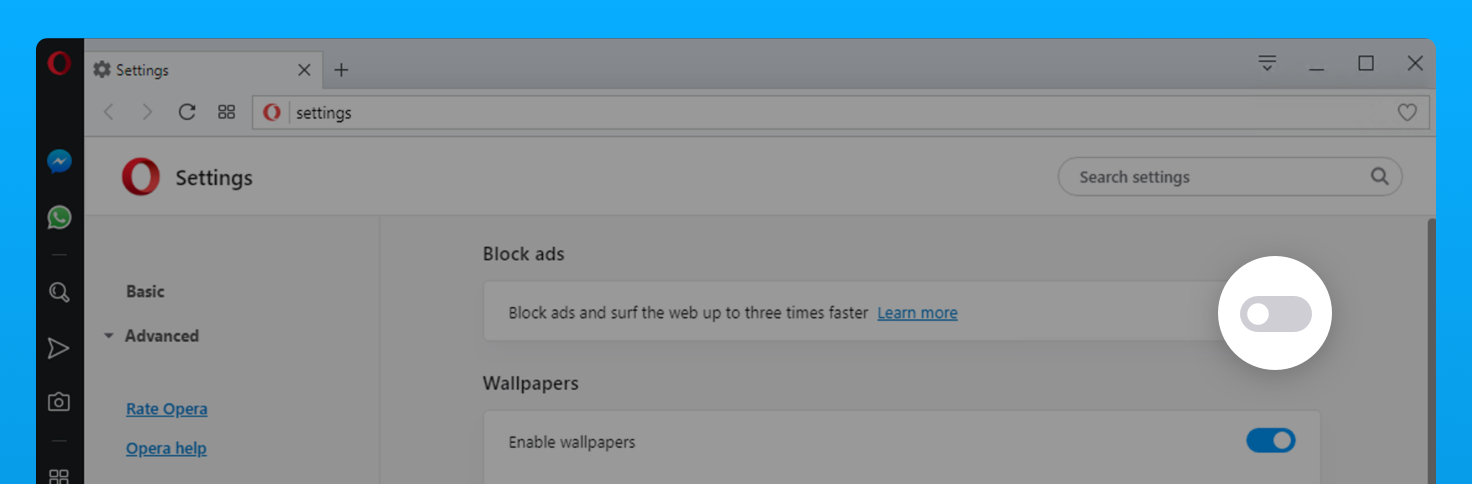
The blue ad blocker bluecoat on the right side of the combined address and search bar shows that the characteristic is enabled.
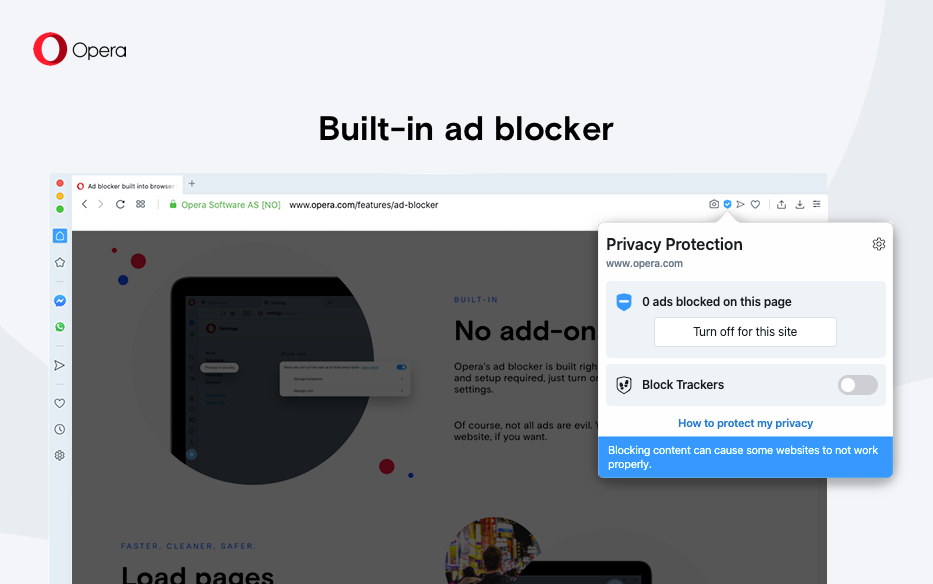
Click the ad blocker icon to open the ad blocker pop-up window. In this window you can optionally disable ad blocker for the electric current website. You tin can also enable/disable the Tracker blocker, or click the gear icon to be taken to the settings folio for ad blocker.
Whitelist a website in Opera's ad blocker
Some websites request that you disable advertizement blocker and then you can visit and fully bask their webpage. Instead of having to completely turn off Opera's ad blocker to visit one site, you can whitelist the requesting website.
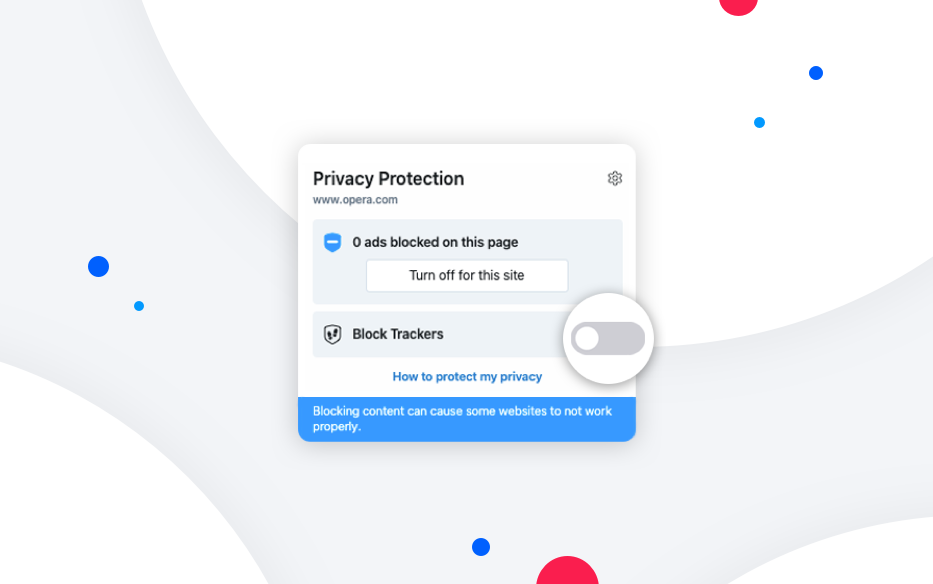
To practise this, open up the ad blocker pop-up window in the combined address and search bar and click the Turn off for this site button. This will disable advertising blocker on that site. In the same popup, y'all can also enable/disable the Tracker blocker, or click the gear icon to be taken to the settings folio for ad blocker.
Opera's ad blocker pauses when you visit a whitelisted website and resumes when you navigate to some other website, allowing for an uninterrupted browsing feel.
The whitelisted website's domain is added to your ad blocking exceptions list. Read beneath to learn how to manage exceptions for Opera's ad blocker.
Managing filter lists for Opera'southward advertizing blocker
You lot can choose which filter lists Opera's ad blocker uses when the feature is enabled. EasyList and NoCoin are enabled by default. To manage lists in Opera's ad blocker:
- Go toSettings.
- In Privacy protection, netherCake ads, click Manage lists.
- Check the boxes next to the lists you desire enabled for ad blocker.
Opera updates your selected lists automatically. You can update the lists manually by clicking the Update button at the elevation of the folio.
These lists, likewise known every bit filter lists, contain rules that tell ad blockers which content is likely to be an advertisement. The well-nigh popular and usually used list for removing ads on international websites is EasyList. Opera includes boosted lists, such as EasyPrivacy, NoCoin, and lists for multiple languages, in order to remove ads.
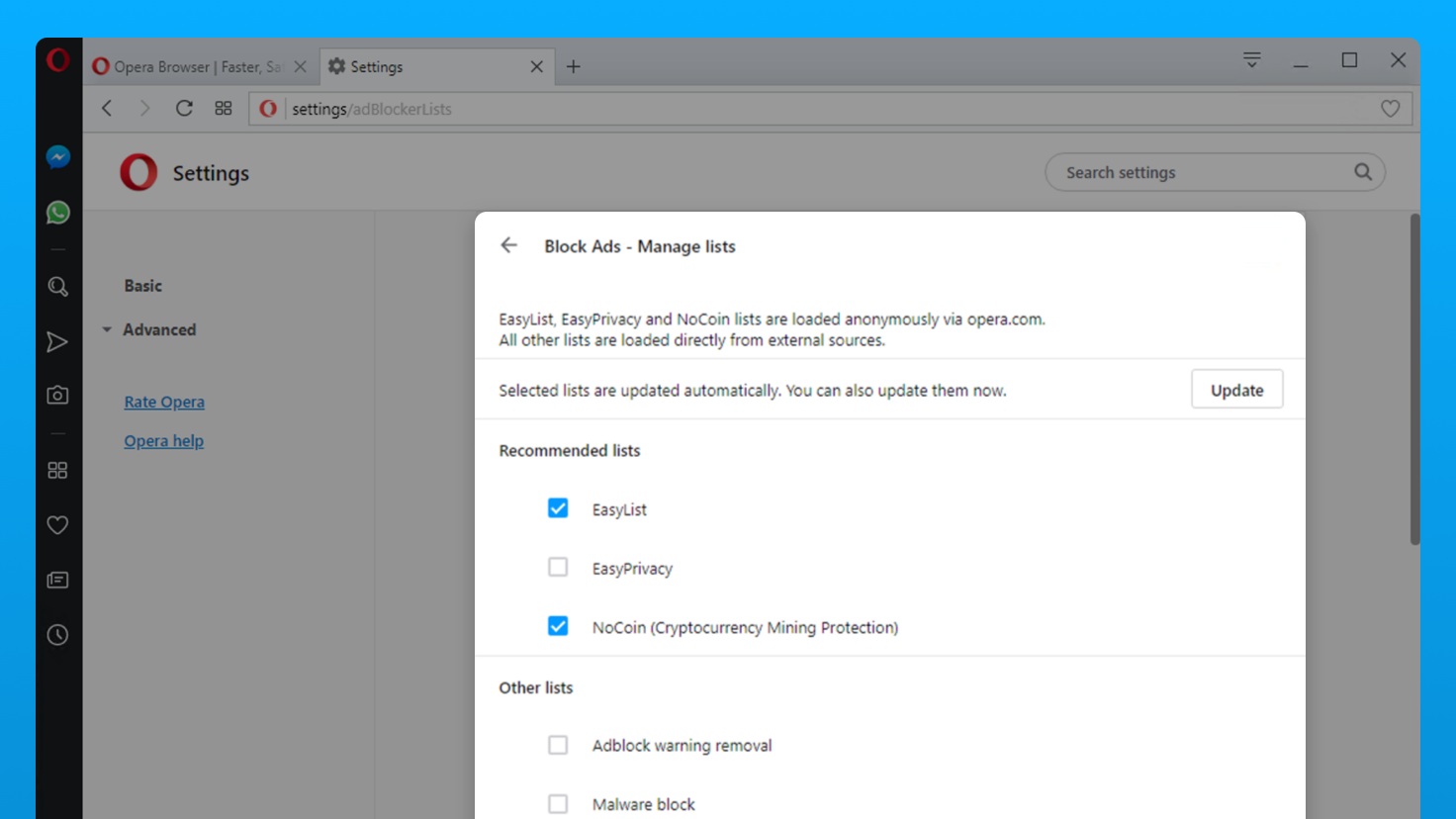
NoCoin is a cryptocurrency mining protection filter list which stops crytpojacking scripts from running on your estimator. Read more than about Opera'due south cryptocurrency mining protection.
Larn how to turn ad blocker on or off.
VPN
Ordinarily, your browser connects directly to websites, allowing websites to identify your IP address and estimate location. With VPN, you connect to websites via a VPN (virtual private network) server. As a result, your apparent location changes to the location of the server. To enable VPN:
- Get to Settings.
- Click Advancedin the left sidebar, and click Features.
- NetherVPN, plough onEnable VPN.
When you enable VPN, it starts automatically, and a VPN bluecoat  appears in the combined accost and search bar. Click on the badge, and you will see an on/off switch, information about the amount of information transferred, the virtual location, and the virtual IP address.
From the betoken of view of websites, your browser is now located in the region given by the virtual location. To change your virtual location, select a region from the list. If you practise not choose a region, you lot are automatically assigned an optimal location. To turn off VPN, flip the switch in the badge.
Because the connection from your browser to the VPN server is encrypted, even if the local network is not, VPN enhances your privacy on the local network. You tin hide your browsing activities from other users of that network.
To enhance your privacy with regard to websites, making it more than difficult for them to track you, you lot demand a combination of features. The effect is cookies. Even if you lot disguise your location, websites tin can withal place you if they have set a cookie. Observe, notwithstanding, that by blocking ads you lot block the source of many tracking cookie. At the end of a private browsing session, when yous close the browser, all cookies from that session are deleted.
VPN is a complimentary service, and the amount of data you are allowed to transfer is unlimited.
Private window
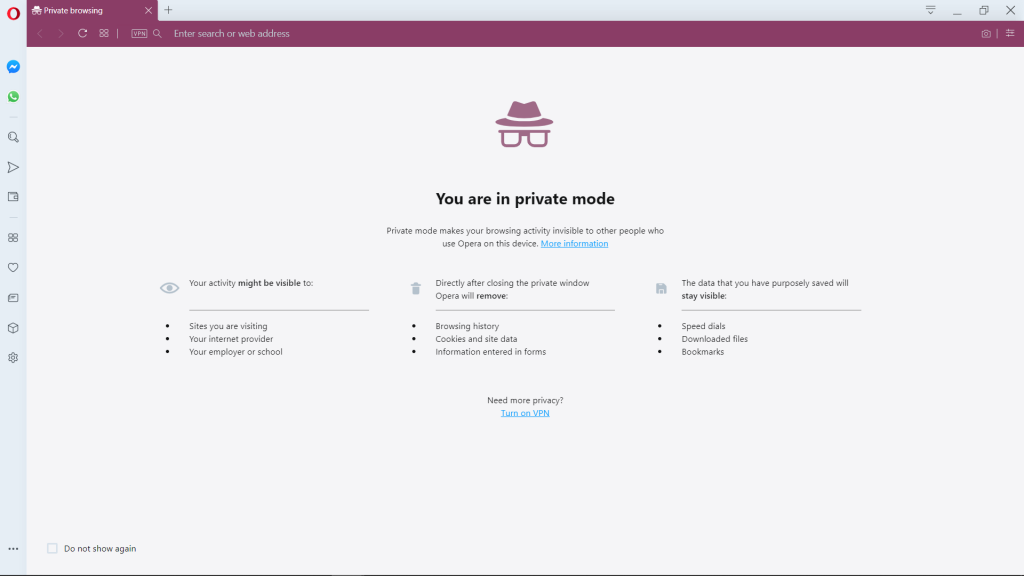
Private browsing ensures that your internet history and activity data is removed as presently as you close all private windows.
- To browse privately on Windows and Linux, get to
 Menu > New private window.
 - To scan privately on Mac, selectFile > New Individual Window (Ctrl+Shift+N).
When you close all private windows, Opera volition clear the following associated data:
- Browsing history
- Items in cache
- Cookies
After beingness closed, a private tab or window cannot be recovered from theRecently Closed listing in the tab bill of fare.
While private windows practice not leave any record of the websites you visit, if you deliberately save data – for example, if y'all relieve an item to your Speed Dial, relieve a password, or download a file – it will still exist visible subsequently the window is closed.
Clear browsing data
By default, Opera stores certain browsing information to assistance speed upwards connections, load common page elements, and improve your interaction with the sites you visit. Y'all may wish to remove traces of your browsing habits past clearing your browsing information. To articulate browsing data:
- Go toSettings.
- ClickAdvanced in the left sidebar, and click Privacy & security.
- UnderPrivacy and security, clickClear browsing data.
- Select a fourth dimension range and the types of data you wish to clear, and clickClear information.
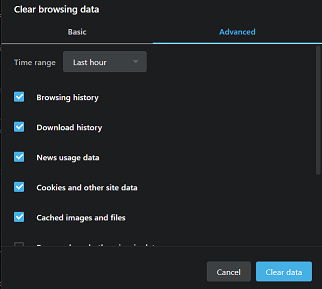
Browsing history – A listing of sites you have visited.
Download history – A tape of the files you've downloaded. Clearing this will non delete the file you downloaded, simply the tape of where and when.
News usage data – Information on the frequency and the length of fourth dimension y'all spend on a news article from the personal news page, which is used to customize what news you see.
Cookies and other site data – Information from websites you visit which is stored on your reckoner, such equally site preferences and login status.
Cached images and files – Data stored on your figurer by applications or websites to brand processes and site loading faster. Should be cleared periodically.
Passwords and other sign-in information – Information related to logging into websites and applications. Allows y'all to exist signed-in automatically.
Autofill form data – Data like credit-card numbers, names and telephone numbers, which you can choose to shop on your estimator in order to accept forms filled in automatically.
Site settings – Permission data for websites, such every bit whether they can access your microphone or send you cookies.
Hosted app information – Data stored by extensions you accept installed in your browser. Clearing this data volition reset the extension to its default.
Immigration your browsing history will delete any stored location information nearly the pages you lot accept viewed and the times you accessed them.
Clearing download history will empty Opera's record of the files you've downloaded through the browser. This will non delete the file from your local machine, simply the tape of when and where y'all downloaded it.
Deleting cookies and other site information will remove any tracked site data. Read more than almost managing cookies.
Emptying your browser's enshroud volition delete any temporarily stored data from websites. The cache is used to briefly store page elements such every bit images or search queries. Buried data also helps reduce loading times when you wish to access a recently visited site. Emptying cache will clear upwardly space on y'all local deejay.
Immigration data from hosted apps will delete whatsoever information stored past extensions you have installed in the browser. For example, if yous installed a weather extension on Speed Dial and fix your location in its settings, immigration this data will reset the extension to its default and you will have to tell the extension your location again. Notation: Take care not to erase useful data inadvertently. If you are not already familiar with it, try private browsing. The data for private browsing is automatically cleared when you shut all individual windows.
Managing how Opera stores individual data may be useful, every bit an alternative to immigration all individual data. Read more about setting spider web preferences.
Security badges
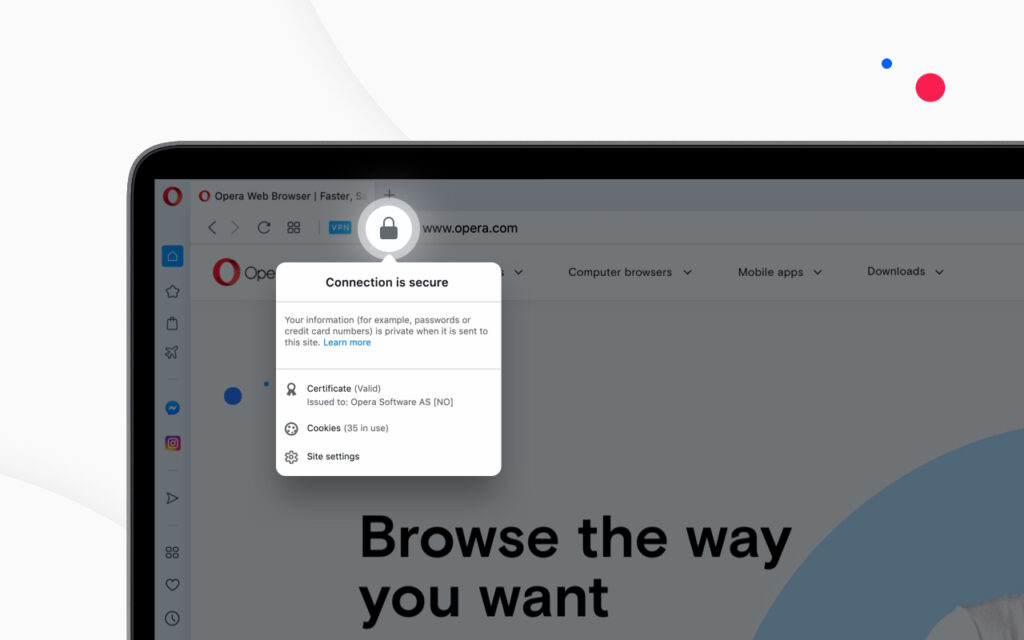
Opera warns you about suspicious pages by checking the folio you lot request against a database of known phishing and malware websites. To protect yourself when entering sensitive information, always await for the lock in the security badge to the left of the combined accost and search bar.
Badges bespeak details near the page you are viewing. When a bluecoat appears in your combined address and search bar, click it to see more information, including security certificates and more.
| Icon | Indicates… |
|---|---|
 | Compressed connexion |
 | Ads are blocked |
 | Camera access |
 | Extension |
 | Fraud or malware warning |
 | Local file |
 | Location access |
 | Microphone access |
 | Opera folio |
| | Secure connection |
 | Unprotected connection |
 | MIDI admission |
| | VPN is on |
When the connection is secure, a lock is displayed in the security badge, implying that no 1 else can read the information that passes between you and the site. Opera uses certificates to verify the identity of the site owners. A lock means there is good encryption between you and the recipient, and the recipient'due south identity has been verified.
If a website is blacklisted, you will be presented with a warning folio, and you tin decide whether to visit the website or to become back safely to the previous page. Fraud and malware protection does not cause any delay in the opening of pages.
Manage security certificates
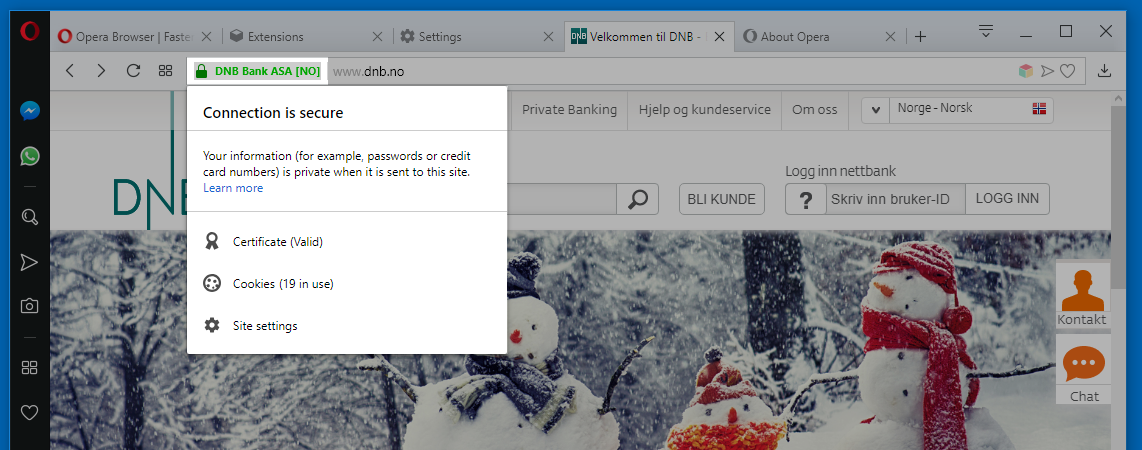
HTTPS (Hypertext Transfer Protocol Secure) is a widely used technology that provides encrypted communication and identity assurance on the Internet. Security certificates are used to verify the ownership of Cyberspace domains. If you lot see a black padlock security badge in your combined address and search bar, and then according to your operating system'south configuration, you are deeply connected to the website. However, information technology is still your responsibility to make sure that the address is correct. When in doubt, blazon the address by hand.
If yous'd like more information most a site'southward security certificate, click on the security badge and click the Certificate (Valid) link. Opera will provide the document'due south issuer, the type of document, and whether the issuer is publicly-known and valid.
Publicly-known issuers and their certificates are validated against a number of security and identity checks. Opera will warn you if some role of a publicly-known issuer's certificate is questionable. You may cull to proceed only Opera cannot guarantee your security.
To see which HTTPS/TLS certificates are used by your Opera browser and how Opera handles them:
- Go to Settings.
- Click Advanced in the left sidebar, and click Privacy & security.
- Under Privacy and security, click Manage certificates.
A note almost local certificate issuers
Some connections tin can be certified past certificates from local issuers, either from apps on your automobile or other non-public sources (such as a local intranet). These issuers tin be used to verify secured connections in the browser. Most of these connections are valid. For instance, debugging applications, third-party security scanning, and parental filters may rely on locally-issued certificates.
Connections certified by certificates from local issuers aren't screened by the aforementioned security standards as publicly-known issuers and certificates. Such screening is too strict and may not permit connections to work as intended. Malware or viruses may utilise these certificates to view encrypted information or inject ads.
If you wish, you lot can configure Opera to warn you about public sites that employ certificates from local issuers. If you proceed to browse on these connections, be aware that some security measures, such equally certificate pinning and Certificate Transparency, volition be disabled for all such connections during your browsing session.
Review how to manage security certificates.
Invalid certificate warnings in Opera
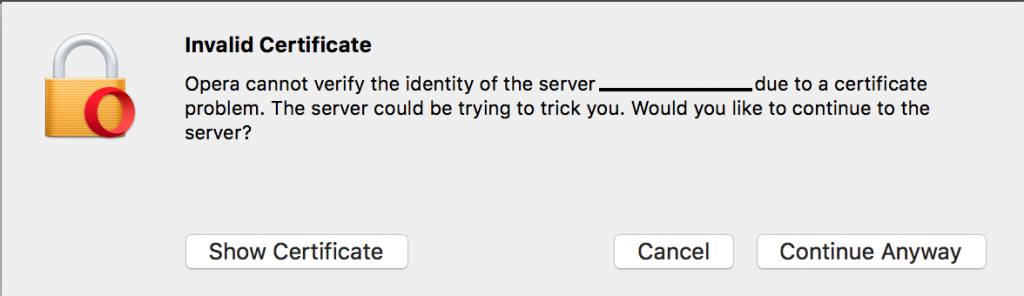
If Opera cannot verify the identity of the server for a website yous wish to visit, you will see this popular-upwardly. Click Show document to review the certificate yourself. When reviewing the certificate, check that the certificate's validity date is current and that the issuer of the document is trusted.
Click Continue anyhow to continue to the website.
If y'all do non trust the server or the certificate and you wish to not proceed to the website, click Abolish.
A note about Extended Validation (EV) certificates
The best guarantee of a website's identity is provided past Extended Validation (EV) certificates. Extended Validation means that the details of the system buying the certificate have been audited by an accountable, third-party entity, who can therefore verify that the certificate owner is who it claims to be. EV websites are indicated past a black security badge with a padlock in the accost field.
Extended Validation certificates are designed to endorse a company'southward validity every bit a reliable, rather than transient, business. For example, to obtain a certificate, a company must provide three years of tax records and other financial data to the Certificate Authorisation. This certification provides peace of listen and security for Internet shoppers.
Opera has already implemented procedures and processes for EV certification and is at the forefront of complying with standards. We accept built-in procedures to automatically verify that everything in a certificate for a website is correct when someone visits a page on the site and that the certificate has not been revoked.
Tell sites to not track your activity
Nearly sites runway your beliefs while you lot visit them. If you do not similar this idea, Opera can ship an additional header with every request: "DNT: 1". This is a flag to websites that the user does not want to be tracked. Some countries accept DNT legislation that will legally protect your request and nigh well-behaved websites will respect this additional header.
You can fix Opera to tell sites you prefer to opt-out of online behavioral tracking. To set this:
- Go to Settings.
- Click Advancedin the left sidebar, and scroll down to Privacy & security.
- Click Cookies and other site data.
- Under Cookies and other site data, turn onTransport a "Do Non Runway" request with your browsing traffic.
A note most phishing and malware
Opera'south fraud and malware Protection warns you lot well-nigh suspicious web pages and is enabled by default. It checks the requested folio against several databases of known phishing and malware websites, called blacklists. Although it is non possible to totally eliminate the gamble of encountering an unidentified phishing or malware website, the risk is minimized.
Note that checking against the database does not filibuster the opening of web pages.
Phishing
The growth of Internet commerce has given online criminals an opportunity to steal your passwords, your credit carte numbers, and other personal information past impersonating authority figures from your bank or other institutions you frequent. This is known as phishing.
Yous will exist encouraged to log in and "verify" your customer information: in other words, to reveal your password, credit card number, or other private data. The best defence force against this threat is to be enlightened of the trouble and to exist alarm when transacting business online.
Malware
For the same reason that y'all have anti-virus software installed, you lot may want protection from websites that distribute viruses or other malicious software, collectively known as malware. The concept of malware encompasses not just viruses, just as well scripts that may run automatically when y'all load a web page.
Source: https://help.opera.com/en/latest/security-and-privacy/
0 Response to "How To Change My Privacy Settings On Domain_6"
Post a Comment