

How To Set An Antique Clock
For thousands of years, humans have used devices to measure and keep track of time. The electric current system of time measurement dates back to approximately 2000 BC and the ancient Sumerians. These ancestors sometimes used quite a flake of ingenuity to keep track of the passing day. These days it'southward very easy to keep track of time on numerous devices, from cell phones to tablets and iPads. Check out fifteen of the most interesting types of clocks.
Mechanical Clock
A mechanical clock is made from simple mechanical components that aren't electrical. Usually powered by a coiled leap or falling weights, common mechanical clock examples include grandmother, grandad and cuckoo clocks. The accuracy of the clock depends on its construction and the engineering of its components.
A pendulum clock uses a pendulum for time dividing. This improves the clock's accurateness because the swinging has a special holding. The length of the pendulum determines the time for the pendulum to swing back and forth. The pendulum's weight and arc don't affect the swinging, resulting in consistent time dividing.
Alarm Clock
An alarm clock is designed to alarm an individual or group at a specified fourth dimension. The primary function of these clocks is to wake people up in the morning or after naps, merely they can be used for other reminders as well. Nearly utilise audio, although some warning clocks use calorie-free or vibrations. Most warning clocks terminate automatically after a sure time, or you tin can manually press a button or handle to cease the alarm.
Atomic Clock
Atomic clocks are calibrated against the frequency of a resonating atom, ordinarily cesium. As a result, they are highly authentic. The NIST-FI atomic clock at the National Institute of Standards and Engineering science in Boulder, Colorado, is accurate to less than a second in more than than 60 meg years. Because these clocks are expensive scientific tools, they are used mostly in laboratories.
Stopwatch Clock
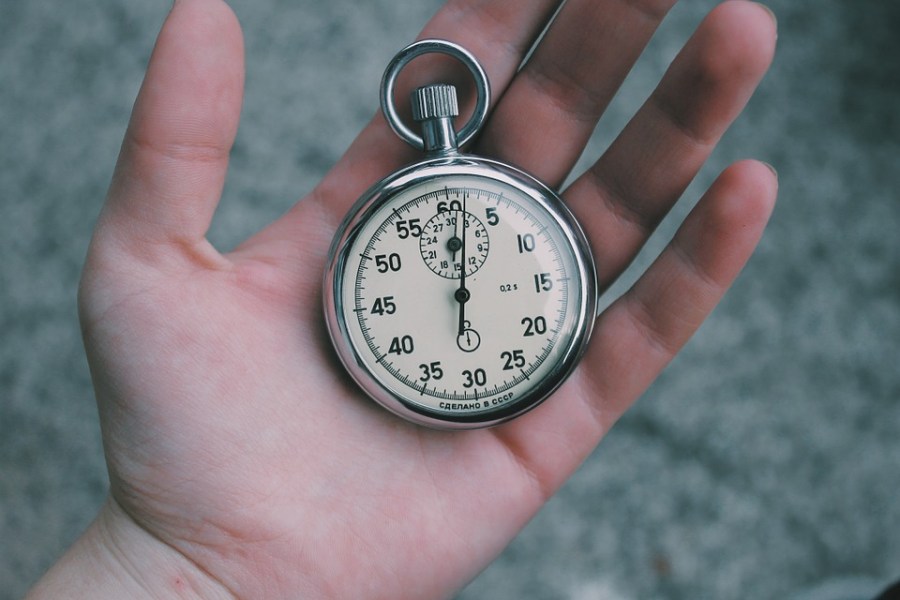
Stopwatches are used to accurately time events. In fact, they don't tape the time of day or nighttime; they merely record how long it takes to perform sure functions. Indispensable in races and sporting events, some stopwatches can time multiple events. Some can fifty-fifty track parts of an event in addition to the full event time.
Hourglass
An hourglass measures fourth dimension by assuasive sand or another substance to period betwixt two glass bulbs connected vertically past a narrow cervix. This construction allows a regulated trickle from the upper bulb to drop to the lower 1. Factors that touch the fourth dimension interval include sand coarseness, sand quantity, neck width and seedling size. Hourglasses may exist reused indefinitely by inverting the bulbs once the upper seedling is empty.
World Clock
A world clock is a clock that displays the time for diverse cities around the world simultaneously. It tin can come up in various forms, such every bit multiple round analogue clocks with moving hands or multiple digital clocks that characteristic numeric readouts. Some world clocks feature a picture map of the world embedded with digital or analog displays.
Quartz Clock
Quartz clocks use an electronic quartz crystal oscillator and a frequency divider or counter. This crystal vibrates when electricity passes through it, and the vibration is very consistent, resulting in a very reliable machinery for time keeping. The quartz crystal and electrical circuits are referred to as the quartz oscillator, while the crystal's oscillation is known as the piezoelectric effect.
Candle Clock
Used in ancient times, a candle clock is a thin candle with consistently spaced markings. When burned, the passage of fourth dimension is indicated by the level of the markings. These clocks provided an constructive fashion to tell time at night, indoors and on cloudy days.
Sundial (Sun Clock)
The sundial measures the fourth dimension of day using the direction of shadows cast by the sun. Every bit the sun moves from east to due west, the shadows formed tell the fourth dimension. The Egyptians were the showtime to utilise sundials, and a well-designed sundial can nonetheless mensurate local solar time with reasonable accuracy today. However, it requires the sun to shine and doesn't work at all at nighttime.
Torsion Pendulum Clock
This type of mechanical clock keeps time with a mechanism called a torsion pendulum. Information technology consists of a weighted disk or bike suspended by a thin wire or ribbon, called a torsion or suspension spring . The torsion pendulum rotates around the vertical axis of the wire, twisting it, instead of swinging like a regular pendulum. The strength created by the twisting torsion leap reverses the direction of rotation. This allows the torsion pendulum to oscillate slowly, clockwise and counterclockwise.
Astronomical Clock
An astronomical clock is a clock that features special mechanisms and dials to brandish astronomical information. It shows events such as the relative positions of the moon, lord's day, zodiac constellations and sometimes major planets.
Pocket Lookout
A pocket picket is made to be carried in a pocket. Consequently, these watches were the most common type from the time they were developed in the 16th century until the advent of wristwatches after World State of war I. These watches generally have an attached chain that allows them to be secured to a lapel, waist coat or chugalug loop to prevent them from being dropped.
Digital Clock
Digital clocks brandish a numeric representation of time. Two numeric brandish formats are commonly used on digital clocks. These clocks generally utilize a LED or LCD display in either 12- or 24-hr notations.
Analog Clock
Analog clocks usually indicate time using the angles of the clock hands. The almost commonly used clock face uses a fixed numbered punch and moving easily. The clock usually has a circular calibration of 12 hours, which also serves as a scale of lx minutes.
Source: https://www.questionsanswered.net/article/15-different-types-of-clocks?utm_content=params%3Ao%3D740012%26ad%3DdirN%26qo%3DserpIndex
0 Response to "How To Set An Antique Clock"
Post a Comment